Showing posts with label In Good Faith column. Show all posts

Dec 28, 2025

Christmas in the Backseat

In my Christmas column, which appeared in our local paper, I wrote about unusual births and the miracle of God entering our world amid less-than-ideal circumstances.


Christmas in the Backseat


You may have seen the recent story about a woman in San Francisco who gave birth in a self-driving taxi. She went into labor, called for a robo-taxi to take her to the hospital, and didn’t quite make it before giving birth to a healthy baby in the backseat. According to the company, “the car has been removed from service for cleaning.”


For Christians, this time of year focuses our hearts and minds on another unusual birthing experience. Jesus was born, not in a sterile maternity ward or behind the fortified walls of a palace. He wasn’t laid in a beautifully hand-crafted crib fit for a king. Rather, after his family found no room at the local inn, he was born in a humble stable and placed in a feeding trough.


This certainly wasn’t how Mary envisioned the arrival of her newborn son. Just as I can’t imagine it was the young woman in San Francisco’s dream to give birth all alone in a cyber-taxi. 


Yet God takes all that is not ideal — the mud and muck of the stable, the sense of isolation and abandonment — and transforms it into hope. One of the most remarkable claims about the Christian faith is that we worship a God who entered into relationship with us in less-than-ideal conditions.


Yet God sent his only Son into the very heart of the human condition. Jesus comes to us not in spite of, but precisely because of, our brokenness and sinfulness. He enters directly into the messiness and disarray of our lives. 


And I find that incredibly hopeful. Why? Because God gets it. God understands our hopes and our fears, our desires and our shortcomings. And God loves us anyway. Despite whatever may not be ideal in your own life in this moment, God loves you, and delights in you, and will never, ever abandon you. 


That’s the miracle of Christmas. Not that everything is perfect — we don’t live in a Hallmark Christmas movie where problems magically resolve and there is always a predictable and happy ending that takes place before the credits roll. The miracle is that God sees our struggles and enters into them. 


In that holy stable, God enters the fray of the human condition, and then continues to walk alongside us, rather than standing at a safe distance. God takes all that is not ideal in our lives — the loneliness, the brokenness, the fear, the heartbreak — and through relationship with us, transforms it all into a loving, liberating, life-giving hope.


So perhaps it’s fitting that during the twelve days of this Christmas season, we spend a moment reflecting on a birth in the backseat of a driverless taxi. Life doesn’t always unfold in the ways we plan for or prefer. But even there — in the unexpected, the inconvenient, the imperfect — new life breaks forth. That’s what happened in a taxi in San Francisco last week, and that’s what took place in a manger in that little town of Bethlehem.  

The Rev. Tim Schenck serves as Rector of the Church of Bethesda-by-the-Sea in Palm Beach.

Dec 24, 2024

In Good Faith: Christmas Rising

 Merry Christmas! Here's a column I wrote for the local paper. 

Christmas Rising


One of the great things about living in South Florida in December is the ability to take morning

walks along the beach. I mean, technically I could have done this when I lived in New England, but it would have been a lot less pleasant. Jack Frost nipping at your nose, and all that. Frankly, I really don’t need to see my breath ever again.


But I love taking our dogs for walks on the beach every morning and watching the sunrise. Like snowflakes — which I also don’t miss — no two sunrises are alike. The interplay between light and clouds, horizon and sky leads to infinite possibilities and a kaleidoscope of ever-changing hues. If you ever wonder whether there is, in fact, a God, I highly recommend daily walks along the beach. And this has absolutely nothing to do with that whole “footprints in the sand” business. 


One of the things I can’t help but notice on these walks is the number of people holding up cell phones to capture the moment. At one level, I get it. When we experience stunning beauty, we want to capture it, or memorialize it by adding it to our phone’s camera roll. We want to relive special moments, or what I would consider glimpses of glory, over and over again.


Of course, there are two problems with this. First, despite all the advances in cell phone technology, our amateur images can’t possibly capture the wonder of creation. They can’t recreate what your eyes see and what your heart experiences when the sun breaks the plane on the horizon at the dawn of a new day. 


And second, I want to yell in my best grumpy old man voice, “Put down your phones! Look at the beauty that surrounds you!” I don’t do this, though. Mostly because it would scare the dogs. I simply wish people would delight in the natural beauty of the earth rather than trying to be the next great Instagram influencer. 


One of the great spiritual gifts is the joy of wonder. Not trying to capture an image of wonder, but simply the wonder itself. Christmas is a season of wonder. I don’t mean this in the “It’s the most wonderful time of the year” kind of way. Because that just makes me think of a car commercial. Nissan, I think. 


But to revel in the “wonders of his love,” as we sing in Joy to the World, is at the heart of the nativity story. The shepherds quake, the angels sing, and the world rejoices as God enters the world in human form. For Christians, the Son of Righteousness shines brighter than even the sun itself. And all we can do is gaze in wide wonder as the Christ child is born anew in our hearts and in our world.


However and wherever you celebrate Christmas this year, whether with us at Bethesda-by-the-Sea in Palm Beach or at another spiritual home, please know that you yourself are a wonder of God’s love. The same God who created the heavens and the earth, the moon and sun and stars, also created you and loves you with deep and reckless abandon. 


Through the birth of God’s son, a light truly does shine in the darkness at Christmas. May the wonders of his love be with you and your loved ones this holy season.


Photo credit: Juergen Roth 

Mar 8, 2023

In Good Faith: Sticking it Out

In my latest In Good Faith column, I write about stick shifts, and getting stranded on the side of the road. 

Sticking it Out


I still drive a stick shift. They’re increasingly hard to come by these days, but in addition to making me feel like a NASCAR driver while racing up and down the streets of Palm Beach in my Volkswagen Jetta, there’s another built-in advantage: it’s an anti-theft device. Who’s going to steal a car no one knows how to drive anymore? I mean, not even my young adult children can steal it. They never learned how to drive a stick. Despite my pleading (“What if there’s an emergency and the only car available has a manual transmission? You could be the hero!”), they just rolled their eyes and borrowed mom’s car. 


I hadn’t thought much about this — it’s just something I’ve always done — until the clutch went out a couple weeks ago while I was picking up a friend at the airport. But I had lots of time to contemplate life and clutch pedals as I sat on the side of the road just outside the entrance to the arrivals terminal. For five (!) hours.


If I’m honest, it was less contemplation and more endlessly scrolling on Twitter. But there was some contemplation. At one point, I got out of my stranded car and stared up at the stars in the sky. I thought about life and faith and God. Until the sprinklers on the median started going off and I got drenched. 


For Christians, the arrival of the season of Lent is, among other things, a time specifically set aside for self-reflection and contemplation. Sometimes we’re intentional about this and sometimes circumstances force us into contemplation. I usually rue these moments — the Wi-Fi goes out, I temporarily lose my phone — but later end up giving thanks for the opportunity to unplug and spend some time with my own thoughts.


Here’s the thing though. Contemplation and technology aren’t mutually exclusive. There are a whole host of meditation apps and ways to use technology to settle the mind. I use a prayer app from Forward Movement to pray the Daily Office every morning. And during my time trapped in my car with the sprinklers making me feel like I was in a particularly intense carwash, I used the app to pray Evening Prayer, giving thanks for all the blessings of life, especially for the fact that I wasn’t stuck in a snow storm.


This Lent, I encourage you to be intentional about spending time in prayer or contemplation. Whether by unplugging or plugging in, the point is that we need such time to stay grounded and connected to the life that exists beyond the visible world. 


Here at Bethesda-by-the-Sea, the church is open during the week and we encourage people to take some time to sit and contemplate life in our sacred space. If you seek an oasis to get out of the fray for awhile, whether inside the church or by walking through our beautiful grounds (yes, we have a koi pond), please know that you are always welcome. I promise I won’t even try to baptize you!


AAA did eventually come to rescue me. And $1,000 later my clutch is back to its old self. I guess you could say, I’m financially poorer, but spiritually richer for the experience. 


Jan 22, 2023

In Good Faith: No Room for Hate

In my latest In Good Faith column, I write about the need for Christians to take a stand against anti-semitism, in light of a recent local incident.

No Room for Hate

There’s a famous photograph taken in Kiel, Germany, in 1932, from the inside of a rabbi’s home

that stood directly across the street from the Nazi party headquarters. It shows a menorah in the window facing a large Nazi flag. On the back of the original photograph, which was taken on the eighth night of Hanukkah, is a handwritten note that declares, “Our light will outlast their flag.”


I’ve always been mesmerized by both the image and the accompanying words. They serve as reminders that God is larger than the sinful machinations of humanity and that hope shines even amidst the deepest darkness and despair.


In the Christian tradition, we look to the poetic prologue to John’s gospel to discover that sense of hope. In words teeming with the language of incarnation, we hear that “A light shines in the darkness, and the darkness did not overcome it.” For Christians, this is the Light of Christ; of God entering the world in human form. 


But beyond the specificity of this light is a universal yearning for hope, equality, and justice that transcends the lines of belief. Which is why the menorah in the window offers us all hope in the face of despair. A reminder that light does indeed shine even on the darkest of nights. 


Last Saturday night, antisemitic images and messages were projected onto an AT&T building in West Palm Beach. This isn’t something that only impacts the Jewish community. It is an affront to all that is good and holy and sacred to people of every faith tradition. As Rabbi Moshe Scheiner of Palm Beach Synagogue put it, “We cannot remain silent.” 


And so I write in solidarity with our Jewish friends to publicly condemn antisemitism in general and the recent messages of hate in particular. There is no place for anti-Semitism in Christian faith and practice, and no place for such hatred in our society. When some among us are threatened, we are all threatened; when some among us are hurting, we are all hurting; when some among us are attacked, we are all attacked. The rise in antisemitic rhetoric from celebrities or politicians cannot be tolerated or left unchecked. Nor can situations where violence is perpetrated upon Jews. 


The fact is, according to the Anti-Defamation League, the past two years have seen the highest incident rate ever for documented reports of harassment, vandalism, and violence directed against Jews. Christians cannot remain silent.


I hope you will join me in praying for the restoration of tolerance, for an end to bigotry in our midst, and for greater understanding and harmony in our community. 


This past December the original menorah from the photograph was lit in Berlin, 90 years after the rabbi and his family fled Germany. The light did indeed outlast their flag. And it is incumbent upon all of us, to be bearers of this light in the world.


Jan 12, 2023

In Good Faith: Swinging for the Fences

In my January In Good Faith column, I write about my lack of golfing skills and why it's okay to give something up as a New Year's resolution.

Swinging for the Fences


Before I accepted the call to serve as the next rector of Bethesda-by-the-Sea, I felt I needed to

fully disclose an important item about my life to the search committee. It’s always better to come clean before the fact rather than after it, and if I ended up in Palm Beach, I wanted to be certain that this new relationship was built upon honesty not deception. 


So, when the interviews and tour were over, I took a deep breath and told the committee chair that I do not, in fact play golf. I told him this while standing outside the church on Via Bethesda, as I heard golf balls being whacked at the Breakers course right next door. 


Of course I was joking. Mostly. Not about not being a golfer — I’m not one — but about the perceived requirement for clergy on Palm Beach to have a four handicap. I was knowingly feeding into every stereotype about island life. That clergy work for a couple hours on Sunday morning and spend the rest of the week golfing and schmoozing. But perhaps a small part of me just wanted to make sure. Because the real work of ministry, and why I accepted the call to Bethesda, is to create a place of love and welcome for all people, to encourage each one of us to live out our faith in tangible ways, to cultivate generous hearts, and to make God known both in Palm Beach and the wider world.


A couple weeks ago my 23-year-old son who was visiting from Boston, convinced me to join him at a local driving range. You’ve seen it — it’s the one near the airport with the giant netting. Ben likes to hit balls and play a round every once in a while, something he was decidedly not doing back home where it was 5 degrees out.


Now in fairness to my golfing ability, I am a veteran of mini-golf. When our boys were younger there were plenty of outings to courses where I would always be stymied by the towering windmill. This doesn’t actually transfer to a driving range, where the point is to drive the ball, not putt it. So my lack of skills were on display for all the world to see. Or at least that section of the world that was at a driving range in West Palm Beach at 11:30 am on a Monday morning. The real issue, as Ben accurately pointed out, is that I swing a golf club like a baseball bat. Suffice it to say, that it was a long two hours. Blasted two-hour minimum!


In ministry I’m always pushing people to get out of their comfort zones and try something new. Whether that’s a prayer practice, a way of looking at the world, or a committee they never before considered joining, we grow when we challenge ourselves. But just because something challenges us doesn’t mean it’s worthy of our pursuit. I’m not a golfer and will never become one — I tried it and I’m just not interested. In the same way, it’s important to recognize the things that are life-giving and joy-inducing in our lives and the things that aren’t. 


I’m not big on New Year’s resolutions, but giving something up is as worthy a resolution as anything. Think about what truly feeds your soul and consider letting go of something that does not. Even if it’s something you feel you should be doing because everyone else seems to be. Like golf.


Dec 26, 2022

In Good Faith: Dreaming of a White Christmas?

In my first column after a bit of a hiatus (moving, switching jobs, etc), I write about spending my first Christmas in Florida and how what never changes is the timelessness of the Incarnation.


Dreaming of a White Christmas?


This being my very first Christmas in Florida, after serving a church in New England for the past

14 years, I have a few initial impressions. The first being that I can’t fully wrap my head around the fact that it’s Christmastime. Taking the dogs for a leisurely morning walk on the beach in the days leading up to the 25th has dashed all my dreaming of a white Christmas. I couldn’t see my breath, my fingers and toes weren’t numb, I didn’t race home to build a fire in the fireplace, and there was certainly no backbreaking snow to shovel.


And then there were the beautiful evergreen wreaths we bought for the front door of the rectory. They lasted a day or two before they were blasted by the sun and turned brown. But we’re quick learners, and they have since been replaced by artificial ones. 


Finally, certain Christmas carols and hymns land a bit differently down here. In the Bleak Midwinter? Not so much. Frosty the Snowman? Puddle of water. 


By the way, I’m not complaining. In fact, I am all in. I’ll probably be stringing up lights on palm trees next year.


But whether you’re trudging through slush or walking barefoot in the sand, what doesn’t change at Christmas is the timelessness of God’s love for humanity. God entering the world in human form transcends time and space, geography and weather.


And despite the nostalgia for a white Christmas with sleigh bells ringing and walking in a winter wonderland, it didn’t actually snow on that first Christmas Day. How do I know? I’m no meteorologist, but Jesus was born in the Middle East. So the odds of a blast of nordic air smacking the shepherds and angels gathered around the manger the night of Jesus’ birth were about zero.


Of course that doesn’t matter — it doesn’t change anything. Christmas isn’t about some bygone five-day forecast. It’s not dependent upon ideal weather conditions or snow-making machines. It’s about the hope of the world being born in less-than-ideal circumstances. It’s about joy entering our lives amid the mud and muck of a stable rather than a palace birthing room. It’s about a light shining in the darkness, and the darkness being unable to overcome it. It’s about remembering and reaching out to the least, the lost, and the lonely this season.


Wherever you are, whatever your faith tradition, whatever the weather, I hope you’ll open your heart to the Christmas story this year. When we receive it in a way that cuts through the sentimentality of the season, it can’t help but be a vehicle of hope and transformation. And let’s be honest — we could all use a dose of that these days.


If you are seeking a church home or simply want to celebrate the miracle of our Savior’s birth this Christmas, please know that there is always a place for you at the Church of Bethesda-by-the-Sea. But wherever you choose to worship, may God bless you in the year ahead and may you have a very merry, if not particularly snow-filled, Christmas. 


Feb 17, 2022

In Good Faith: Marking Milestones

In my February In Good Faith column, I write about celebrating 21st birthdays amid a pandemic and the importance of marking milestones.

Marking Milestones


When I had recently turned 21, I went out to dinner with my mother. I remember the barely-legal-

herself waitress coming over to our table, taking our drink orders, and demanding in full sincerity to see my mother’s ID. My mom met the waitress’s gaze, pointed at me, and proclaimed, “Here’s my ID — my 21-year-old son!” As I recall, the waitress slowly backed away and brought her a glass of Pinot Grigio.


I thought about this encounter recently as our youngest son, Zak, just turned 21. Now, I’m not sharing this because I’m way too young (in my mind) to have another child of legal drinking age. That’s another story. But Zak was our second child to hit this major milestone during Covid. 


Because restrictions have eased, we were able to take him out to a bar for his first legal drink. Soon enough he ditched us to spend time with friends, but it was fun to recognize and mark this moment with him.


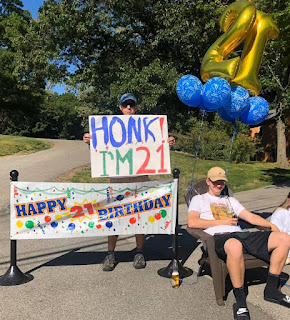
When our eldest son Ben hit the magic age in the midst of the lockdown, we made him sit out in the driveway and hold a “Honk I’m 21” sign. Since we live on Main Street, cars were plentiful, and I swear, I’ve rarely had more fun in my entire life, waving to cars and seeing and hearing the enthusiastic responses.


All of which is to say that marking milestones is important. We do this on birthdays, graduations, anniversaries and a host of other occasions that blend our lives with our calendars. We mark them partly out of obligation and adherence to social norms, but mostly out of love. We celebrate milestones because they mark the very fabric of our lives, and convey just how much we care about the person in question. Without milestones, we may simply overlook chances to celebrate one another in intentional ways. And that would diminish the relationships that matter the most.


This pandemic has disrupted many of our most cherished milestone traditions. Yet I love how we have collectively adapted over the past two years, even as we have pined for a return to the way we have long celebrated together. Speaking of which, will blowing out candles on a birthday cake go the way of bobbing for apples? In a post-Covid world, it’s certainly hard to imagine breathing all over a cake and then inviting people to have a piece. 


But drive-by birthday celebrations, waving to grandma from outside the nursing home, and Zoom holiday gatherings have all been ways we adapted and found ways to mark milestones despite trying circumstances. Whenever we move into a post-pandemic world, I hope this time will help us to never again take these celebrations for granted. Few things in life are as important as recognizing and nurturing our life-giving relationships. 


We’ve proven that we can do this when conditions are less than ideal. And while we may not be blowing germs all over birthday cakes anytime soon, I’m sure we’ll continue to discover new and creative ways to celebrate the most important people in our lives.


Jan 10, 2022

In Good Faith: In the Footsteps of Holiness

In my January In Good Faith column, I write about an encounter (sort of) with the beloved Archbishop Desmond Tutu and the inspiration of walking on hallowed ground. 

In the Footsteps of Holiness


One of the things I cherish about visiting hallowed ground is that sense of walking in the

footsteps of those who exist in our minds as larger-than-life figures.

As a kid growing up in Baltimore, I once toured the dugout and clubhouse of the old Memorial Stadium. As a young Orioles fan, walking the same ground as Jim Palmer, Eddie Murray, and Cal Ripken was awe inspiring. As an adult, I had a similar experience sitting in the Rosa Parks bus at the Henry Ford Museum in Dearborn, Michigan. Being in the physical space where her gentle, yet iron-willed courage played out was incredibly moving to me.


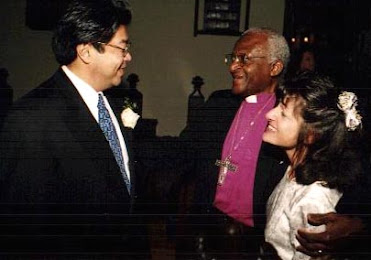
It was in this vein that I learned of another such encounter, one fueled by love and justice. In the days after Archbishop Desmond Tutu died, I was reminded that he once officiated a wedding at the parish I serve. This remarkable and holy man had walked down our aisle and stood at our altar. He had gazed upon our stained glass windows and stood in our Memorial Garden. 


In the days following Bishop Tutu’s death we, along with churches throughout the world, rang bells at St. John’s to offer thanks for his extraordinary witness to the demands of justice and the reconciling power of love. The groom from that 1999 wedding day joined us for a time of prayer and reflection.


Stewart Ting Chong served on Tutu’s staff for seven years during the apartheid era in South Africa. For Stewart, Bishop Tutu was more than a global icon, he was a friend, mentor, and confidant. In reflecting on his friend, he wrote, “There was, for me, no one braver, more outspoken in the defense of the oppressed, the persecuted, and the discriminated, and no one more prayerfully contemplative than the Arch.” 


Several years ago, I was privileged to travel with a group from our parish to visit South Africa. We visited the Apartheid Museum in Johannesburg, toured Robben Island where Nelson Mandela was imprisoned for 18 years, and learned about the Truth and Reconciliation Commission work of Bishop Tutu.


This transformative, inspiring, and heart breaking pilgrimage was made even more poignant when I learned of Bishop Tutu’s connection to St. John’s. Somehow the experiences we shared during that time, which continue to resonate, were made that much more real by the knowledge that the archbishop had, for a brief time, joined us on our journey.


As Stewart also wrote in the hours after the bells tolled in honor of his friend, “The Archbishop’s death is not the end of the battle he waged for goodness. It is the beginning for each one of us who holds his name in high esteem. Discrimination, injustice, persecution and oppression will not end unless we pick up his mantle of righteousness and call to account those who continue to tarnish the ideals that he had so faithfully strived to achieve. Let us find our voice and speak out against oppression. Let us speak out against the injustices inflicted on communities around the world. Let us hold accountable those who plunder the coffers intended to help the weak, hungry, and destitute. And let us put the words we speak into action with righteous indignation and leave this world a better and kinder place for the generations that follow. Let us pledge to continue his work.”


To which all we can do is say, “Amen.” And then get to work.


Dec 19, 2021

In Good Faith: The Mess of Christmas

In the Christmas edition of my In Good Faith column, I write about the messiness of that first Christmas and how it keeps the messes in our own lives - and the world - in perspective. 

The Mess of Christmas


I have nothing against dainty, hand-painted porcelain nativity sets that sit atop mantlepieces in well-appointed homes. Many of them are quite beautiful, especially when accompanied by stockings hung by the chimney with care. And if they draw us into contemplation of the story of Jesus’ birth, I’m definitely on Team Porcelain Nativity Set.

The only problem with them is when they lead us into the temptation of sentimentalizing Christmas. In other words, this time of year should be full of precious moments, but it shouldn’t be all about Precious Moments.


This year, in particular, feels less than precious. Covid is again running rampant, there’s great uncertainty as to how to safely gather at home and in churches, supply chain issues are disrupting our best-laid plans, and everyone is exhausted by the prospect of a third straight year of pandemic living. 


The good news is that our current state of chaos has a lot more in common with the first Christmas than any hand-crafted nativity set. After all, giving birth is messy business! And it must have been particularly stressful to go into labor in a place so far away from family and friends. Not to mention the conditions: cows and sheep are dirty and wander all over the place; shepherds generally need a shower; and angels are terrifying.


And yet, despite all the messiness, despite everything not going according to plan, despite all the expectations not met, Christ our Savior was born. God entered the world in human form not into a state of perfection, but in the midst of a mess. I actually take great comfort in this. Because if Jesus himself arrived into a state of disarray, there’s hope for his entrance into our own often disordered lives. 


Of course, much of the messiness into which Jesus was born had more to do with the human condition than with the maelstrom around the manger. Because unlike that porcelain nativity set, we’re not shiny and perfect and set apart. Rather, we’re flawed and dented and set within the context of our broken humanity. The miracle of Christmas is that, despite our imperfections and the mess we make of things, Jesus still shows up to walk with us, to live with us, to love us.


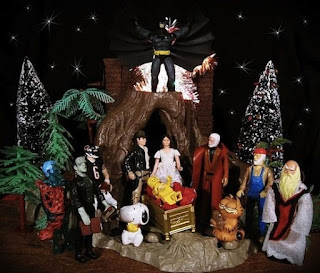
Which means a more accurate nativity scene might be the PlayMobil version my kids had when they were young. The sheep were strewn all over the place, the Magi were replaced with Power Rangers, dinosaurs were involved, and this all took place not on a distant mantlepiece, but on the family room floor. Which feels like a more authentic version of how things unfolded on that long-ago night in Bethlehem — accessible, authentic, and messy.


Whatever we do or fail to get done this Christmas, remember that God will love us anyway. Whatever mess Jesus encounters when he arrives or whatever state of chaos we find ourselves in on December 25, he will love us anyway.


Hold on to that love, friends. And know that whatever mess we’ve made of things, and no matter how messy our world feels right now, God is right in the midst of it all.

Nov 23, 2021

In Good Faith: Stuffed With Gratitude

In the Thanksgiving edition of my In Good Faith column, I write about carbs and why this year feels especially filled with gratitude.

Stuffed with Gratitude


It’s finally happening. After years of conformity, our family has at last spoken the silent part out


loud: we don’t love turkey. I mean, we all think it’s “fine.” There’s nothing inherently wrong with it. For years, we’ve gamely forked a bit of white and/or dark meat onto our plates, passed the platter, and politely asked someone to please pass the gravy. But shouldn’t the Super Bowl of feasts arouse culinary excitement and anticipation, rather than a humdrum feels-like-any-other-Thursday vibe?

“But it’s tradition!” you say. Well actually, if you’ll permit me a moment of mansplaining, there was no turkey served at the first Thanksgiving. The predominant dish was freshly killed deer, and there was also a boatload of Cod, which makes sense given the location. Lobster too, apparently, and I’d be happy to fully honor our heritage and go that route, if only everyone in my family ate lobster. And it wasn’t clocking in at $15 a pound. 


Now, don’t get me wrong. Our family isn’t comprised of a bunch of unenthusiastic tradition thwarters. We all love the Thanksgiving side dishes and, of course, the pies. Personally, I’m all about the carbs. The mashed potatoes, the stuffing, the cornbread. Bring. It. On. And I don’t care how low-brow it is, I always insist on Stove Top stuffing. Go ahead and make your fancy stuffing — I’ll probably have some of that too. As long as I get my annual allotment of Stove Top, I’m happy.


Food preferences aside, this year, more than anything, is about the people. We know it’s supposed to be about the people, but food and football often serve as helpful distractions to our respective dysfunctional families. The distasteful political commentary, the old family wounds, the painful shadow and ensuing shame of perfectionism. 


Yet after last year’s Thanksgiving, which left many among us feeling isolated and distanced from family, this year feels different. Yes, we’re still living in the midst of a global pandemic, but vaccines and boosters have allowed us to gather more safely. Nothing is without risk these days, but the mental health benefits of in-person gatherings, with proper precautions taken, are well documented. We need one another, and it is a good and joyful thing to gather together.


As you do so, please remember our Native American siblings for whom this day is remembered less as a day of gratitude and more as a day of mourning. Those feelings of isolation and distance which we felt last year are experienced every year by indigenous people throughout this nation. This doesn’t mean we shouldn’t gather and feast, but it does mean approaching the table with historical perspective and the awareness that our actions have consequences. Giving thanks to God and being grateful for the bounty that surrounds us can and should incorporate the tears of those who mourn. Which only adds depth and realism to our day of gratitude. 


Of course, family being family, it took forever to agree on a substitute main dish. All sorts of proposals were floated from Cornish hen to filet mignon to Chicken McNuggets. In the end, we all agreed on the ultimate comfort food: homemade chicken pot pie. I can live with that. So hold the turkey; but please do pass the carbs.


Oct 18, 2021

In Good Faith: Walking Humbly

In the October edition of my In Good Faith column, I write about the joys of dog ownership and the importance of humility.

Walking Humbly


On most days, at some point, I can be seen walking down the street carrying a bag of poop. This

would be a much stranger sight if I didn’t also have one or both of our dogs walking beside me.  Yet I find that this small, simple act of dog ownership helps on the humility front. It’s hard to have an outsized view of yourself when you literally carry dog poop around town in a brightly colored bag on a daily basis. 

As Americans, we’re generally not too big on humility. We’re more into keeping up appearances and keeping up with the Joneses. We’re taught to seize the day, that might makes right, that only the strong survive. Rather than lifting up humility as a virtue, we’re more inclined to equate humility with weakness. 


And that’s too bad. Because if we all genuinely embraced humility, I’m pretty sure the world in which we live would be a much more enjoyable place these days. 


Maintaining a healthy and realistic view of one’s own importance isn’t about low self-esteem or self-renunciation. Rather, it’s about lifting others up, leaving space for those beyond ourselves to function more fully in the world around us. It’s about listening to voices besides our own and opening ourselves up to differing viewpoints.


Perhaps not surprisingly, I believe our current political landscape could use a dose of humility. Our politicians could stand to dial back the self-aggrandizement, and people on all sides might recognize that they may, even occasionally, not have all the answers. The amplification of one’s own views on social media surely doesn’t help with the ensuing divisiveness. 


From a faith perspective, without humility we tend to forget our place in the world. Our self-righteousness can take over and we slowly, but surely put ourselves on the same plane with God, rather than taking our place as humble servants of God. Which, in the religion business, is called sin. 


Of course, even faith leaders are not immune to a lack of humility. Joel Osteen drives a Ferrari. There are clerics who revel in the opulence of their office, more concerned with status than service. Which doesn’t leave much room for humility, for giving away power and prestige, rather than stockpiling it. Nor does it speak to the one who humbled himself on a cross. 


Embracing humility doesn’t mean spiritual groveling. We are indeed worthy to stand before God, and we should live with the sure confidence that we are truly and wholly loved by God. But setting ourselves over and above other members of God’s creation is neither spiritually sustainable nor how God intends for us to walk through this world. Which is easy to forget in this age of self-affirmation and self-reliance and self-indulgence and self-justification.


What is it that keeps you humble? It may be walking down Main Street carrying a bag of poop; it may be listening to others before sharing your opinion on Facebook; it may be acknowledging a mistake at work rather than blaming a co-worker. 


I invite you to reflect upon ways that you might walk more humbly through this world of ours. Dogs, of course, are optional.  


Aug 17, 2021

In Good Faith: Hometown Hauntings

In my August In Good Faith column (written on vacation!), I write about visiting my hometown of Baltimore and a Bruce Springsteen song I can't get out of my head.

                                                            Hometown Hauntings

Maybe it’s because his daughter won a medal in equestrian at the Tokyo Olympics. Or perhaps

it’s because I was back home in Baltimore last week visiting my family. But either way, I haven’t been able to get Bruce Springsteen’s song “My Hometown” off his Born in the USA album out of my head this week.


Granted, it’s not the most uplifting track. It’s quite haunting actually, as it tells the now familiar story of an old manufacturing town racked by economic woes and racial strife. By the last verse, the narrator has made the decision to move his own young family out of his “hometown” to seek opportunity elsewhere.


I’m not trying to depress you here. But there is always a strong dose of nostalgia, and even some regret, when we visit our hometowns. There’s often great joy, too, of course. I loved being with my family and watching the five cousins joyfully interacting with one another. Nothing beats that. 


But when you return to a place you haven’t lived for 25 years, there is a tangible sense of loss when reflecting on those no-longer-there places that make up your earliest memories. 


When I drive by the little league field of dreams where I played a mean shortstop for the Bulldozers and see luxury condos, it hurts a little. When I pass my favorite ice cream shop and notice it’s become a dentist’s office, that’s painful. It’s not that we want to live in the past — life goes on, change is inevitable. But it can’t help but feel as if a small part of us has died along the way, a part that we’ll never get back.


Not to be overly dramatic about, say, Jimmy’s Restaurant closing in Fell’s Point (I still can’t believe that one), but it’s okay to take a moment to grieve such losses. To reminisce with old friends and family members about the places and people that meant so much to us, once upon a time. And to remember that it’s not really about the buildings themselves, but about those with whom we shared the experiences.


The kaleidoscope of cherished memories makes up a strong part of our identity, which is precisely the pull of a return to our hometown. It may be bittersweet — memories can be both life-giving and soul-trampling. But, taken together, they help form who we are as individuals.


The good news is that wherever life takes you, whether you’ve stayed in your hometown or moved away, God loves you for who you are. No matter where you’ve gone or what you’ve done or what’s been done to you, God loves you. And I don’t think   it’s possible to ever state that enough.


They say home is where the heart is. Which, when you think about it, offers great freedom to those of us who have left the places of our early roots. Your heart moves with you. Yet even knowing that, it’s okay to acknowledge that a piece of our heart may well remain behind. 


And I still can’t believe I’ll never again eat a BLT at Jimmy’s Restaurant.


Jul 13, 2021

In Good Faith: For the Love of Dog

In my latest In Good Faith column, I write about the loss of our sweet 18-year-old family dog. 


For the Love of Dog


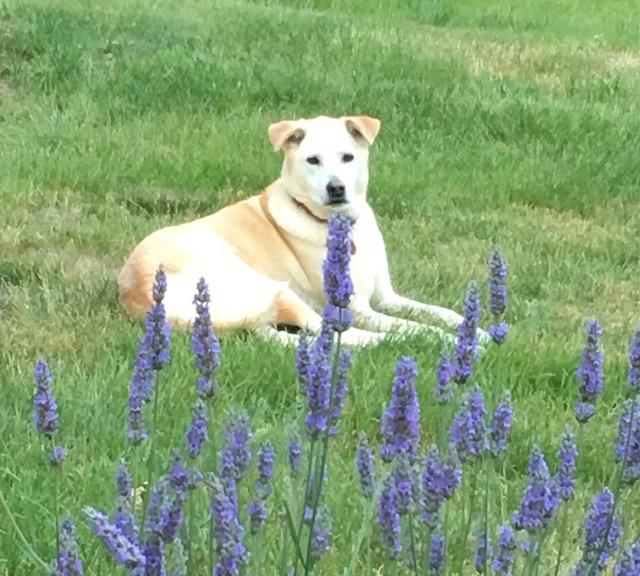
We lost a beloved family member last week. Well, technically speaking she was a member of our “pack,” as that’s how dogs see themselves. But Delilah, our yellow lab/husky rescue left this mortal patch of earth after 18 years and three months. It was an amazing run, not just for the length of time but for the love she doled out along the way.


Officially, Delilah was not a therapy dog, but she had her own ministry of presence at the


parishes I’ve served in both New York and Massachusetts. From welcoming visitors to comforting bereaved families to visiting nursing homes to putting children at ease, Delilah was a faithful companion to so many. Frankly, she was a more faithful pastor than I could ever hope to be, sprinkling unconditional love around with reckless abandon. 


Before being furloughed by both the pandemic and arthritis, Delilah came to work with me nearly every day. I know this was more unusual before all of our pets became co-workers over the past year-and-a-half of working from home. But she embraced her role and her commute, enthusiastically bounding up the stairs from the rectory to the church.


Delilah also served as a marker of time for our family. She journeyed with our children from elementary school to their early 20s; she’s been in every one of our Christmas cards for the past 17 years; she endured countless goldfish, two ferrets, and even our now three-year-old other dog; she accompanied us on an interstate move and countless other adventures. Delilah has simply been there, through all the sorrows and joys and messiness of life. She has seen it all and yet remained overjoyed to see us each and every day.


As anyone who has loved and lost a pet knows, the grief is real. There’s an emptiness that transcends the physical emptiness of the dog bowl and creates a paw-shaped hole in your heart. But it’s also part of the deal. We bring pets into our homes, give them our hearts, love them, allow them to minister to us in ways great and small, and then cherish the memories when they’re gone. The love is as fierce as the grief.


Although I realize it offers comfort to many, I’m less enamored of the whole notion of the “Rainbow Bridge,” that mythical crossing animals make from this world to the next. I am, however, keenly aware of the rainbow that forms over Noah’s ark in the book of Genesis. The rainbow that emerges after the flood, is a sign of God’s promise to never abandon God’s people. As the storm subsides and the rainbow appears, God says, “I have set my bow in the clouds, and it shall be a sign of the covenant between me and the earth.” 


I believe our beloved pets are part of this covenant, and I’m convinced they play an integral role in our relationship with the divine. Through them, we glimpse God’s love for all humanity. In the ways that our pets comfort us and care for us and cuddle with us and even, at times, confound us, we see the very face of God. 


One of Delilah’s great joys in life was stretching out in the backyard and soaking in the sunshine. She could literally do this for hours. Besides the reminder to all of us to enjoy the present moment, something so many of us struggle with, I also hear echoes of the 23rd Psalm as I envision Delilah now lying down in green pastures and reveling in the celestial sun. 


And as the storm of grief abates, I look forward to reveling in the vivid, multi-colored, rainbow-like memories of Delilah that will cheer us all in the days ahead.